
The Migration and Evolution of South Asian Clothing Heritage Around the World
Identity is a constant negotiation between something society wants to label us as and what we want to choose. This is why clothing has always been such a powerful tool in identity-making and choosing. Diasporic clothing becomes a fascinating place to explore this because it involves generations that chose or were forced to find a new home. When South Asians migrated, how did they use clothing to leverage their identity or assimilate to new places? How did clothing evolve to help them negotiate with a different place? How did clothing evolve to not only preserve heritage, but also to signal respect and affection to new homelands? With South Asians, their cloth travelled the world and eventually led to a layered global aesthetic that now represents the subcontinent and its many peoples across the globe. It’s a tale of resilience, hope, and holding on to what means home while also gracefully assimilating with new lands, customs, climates, and materials.
Lengths of home in lands of labour
From Roma travelling west to merchants exploring the Far East, South Asians had been moving, trading and settling abroad for two millennia. The East India Company hired South Asian seafarers from the 17th century too. But where we see distinct patterns of South Asian garments assimilating to foreign climates is after 1845, when hundreds of thousands of South Asians migrated along the currents set forth by the commercial engine of the empire. Labourers were transported to Trinidad, Guyana and Suriname under the colonial indentured labour system. Exploited into contracts that made it unaffordable to ever return home, these migrants carried the memory of South Asia with them, alongside grief and debt, through cloth. The sari and its choli blouse, the dupatta that veiled the head and shoulders, the kurta and dhoti worn by men, the gangri skirt… these garments slowly started seeping into the everyday sights of the Caribbean. Soon, they morphed with climate and material practicalities as well as the propriety codes of the new homes; saree-like draped tops merging with tailored skirts, and kurtas paired with Western pants … In the Caribbean, the South Asian clothing element that survived most notably, across genders, is the dupatta, widely known as orhani in the region. The Caribbean orhani was notably lightweight, all white and cotton, compared to its vibrant counterparts in South Asia. It reflects the practicalities of South Asian migrants in the Caribbean, who were predominantly working in plantations, where the orhani was clothing that protected them from the sun, and for women, also from unwanted male gaze in the fields.
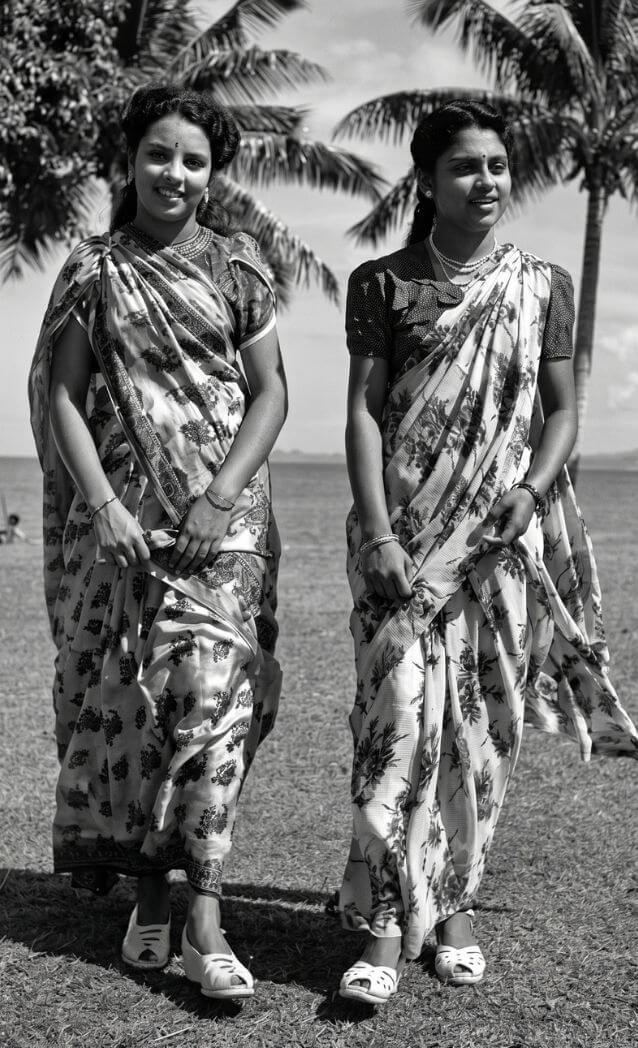
These South Asian clothing elements remain in the Caribbean even today, worn at weddings, rituals, and commonly seen every year around Diwali and Phagwah. Further east, in Fiji, Indian indenture brought the sari and lungi into contact with the Pacific climate and the cheerfully floral bula fabrics settling into something distinctly its own. The brightly floral saris echoing the bula aesthetics of Fiji were a hallmark of how South Asian fashion thrived in new homelands, nurtured by diasporic communities.
But labour wasn’t the only reason for South Asians to migrate with their clothing.
Cloth spread along old trade roads.
For hundreds of years, on the African continent, in Zanzibar, Gujarati merchant communities, Ismaili Khojas and Bohras among them, had settled the island from the early nineteenth century. Theirs was not a story of survival that wrenched them from their homes, but a chosen pursuit of prosperity. This often meant that identity was strategically negotiated for commercial reasons, adopting the clothing familiar to and trusted by the majority in the new homeland. But, for some merchant communities, the optimism for prosperity sat side by side with a loyal sense of duty to hold their heritage close.
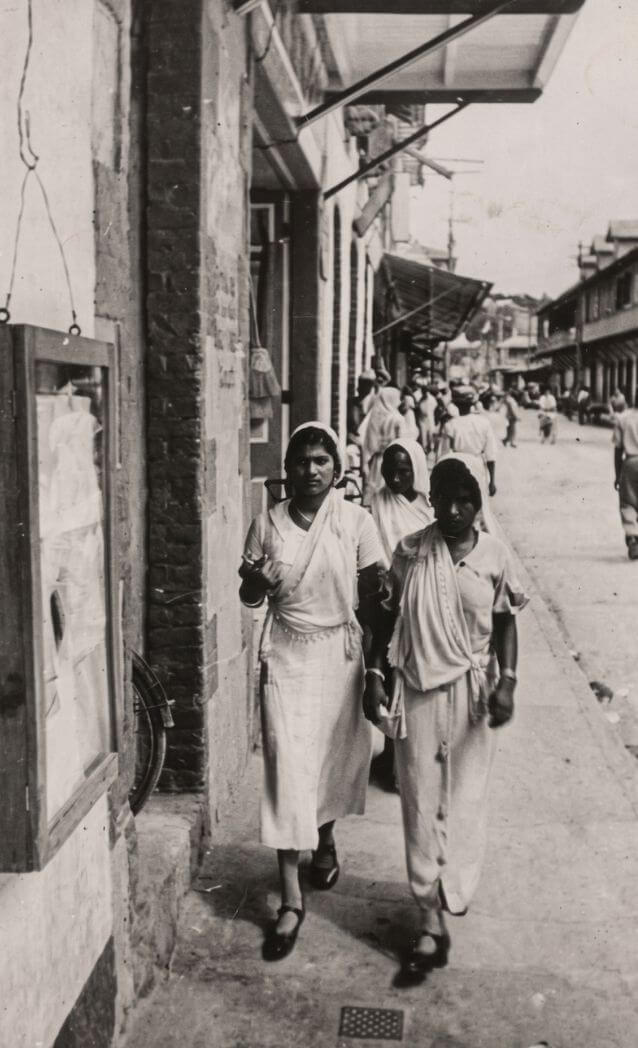
The Bohras in particular held to a dress of their own choosing rather than one dictated by new circumstances and climates: men in a white three-piece saya kurta and gold-edged cap, women in the rida, a two-piece garment worn adorned in embroidery and print. Further east, along the trading routes the British had opened through Burma, Malaya, South Africa and Mauritius, the Nattukottai Chettiars of Tamil Nadu carried their own insistence on who they were through clothing. As moneylenders and financiers to entire colonial economies, rice in Burma, rubber and tin in Malaya, they were rarely mistaken for anyone else: white veshti wrapped at the waist, the body otherwise bare but for sacred ash and heavy gold, a look untouched by the fashions of the ports they came to dominate.
It was a professional signature, instantly recognizable from Rangoon to Singapore, worn by men who did not need to dress like the empires they financed. Even further, Australia’s outback in the nineteenth century saw thousands of cameleers arrive from Punjab, Sindh and Baluchistan (present-day India, Pakistan and Afghanistan); colonial settlers, unable or unwilling to distinguish between the many places these men came from, called them all ‘Afghans’. But their image, complete with turbans and loose, flowing dress, remains a strong signal of South Asian heritage in Australia.
The long-drawn migration
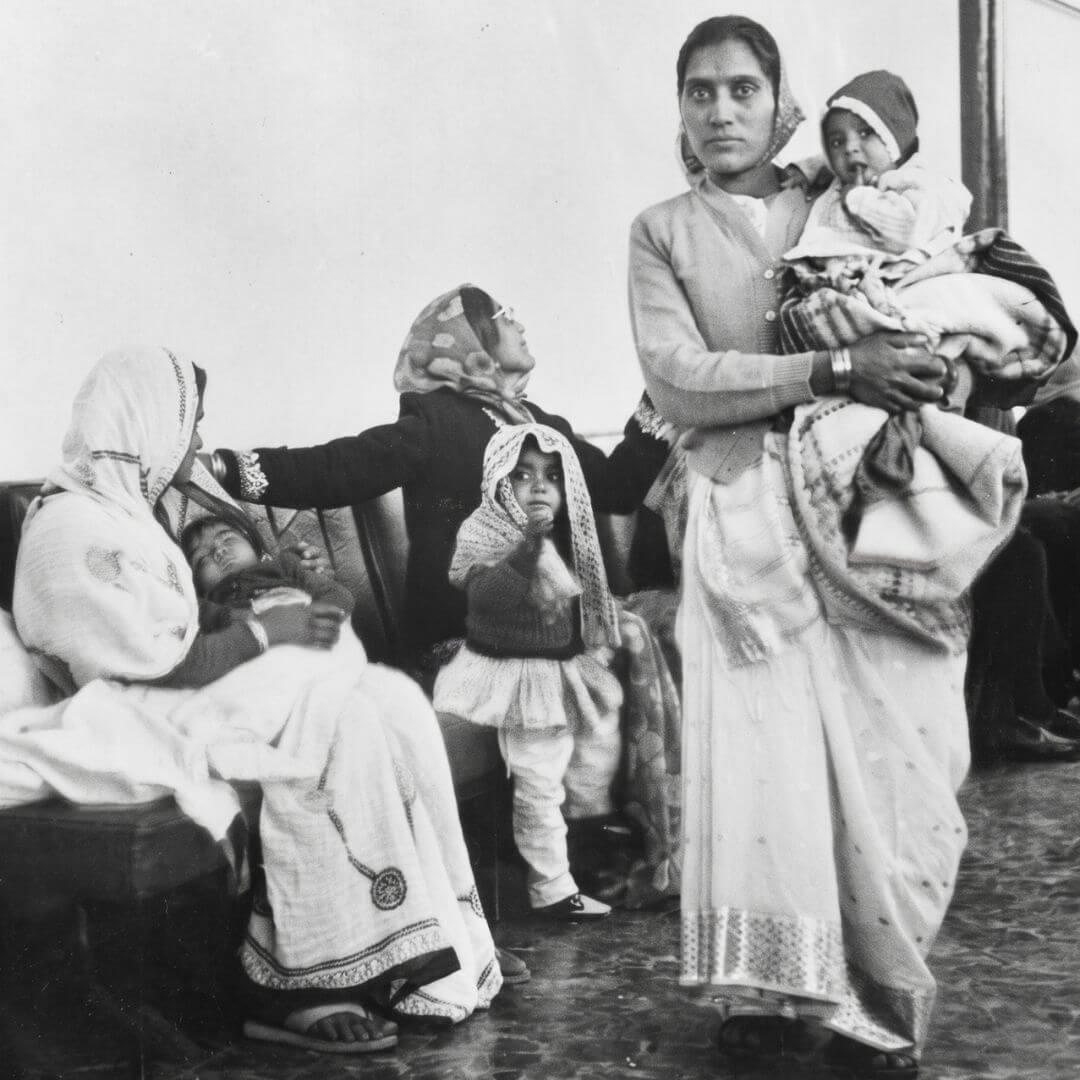
The more recent major migrations of South Asians to the West were shaped by political upheavals like the 1964 Zanzibar revolution and 1972 Idi Amin’s 90-day notice to leave Uganda; both drove thousands of South Asians to Europe, mostly Britain. And to the Netherlands, the descendants of Indians indentured to Dutch Suriname a century earlier left again when Suriname gained independence in 1975. Similarly, Goans found their way to Portugal, and Pondicherry communities chose France, as further routes West.. In each migration, what clothing items were retained was freshly renegotiated. The India-Pakistan partition, the Sri Lankan civil war, the Kashmir conflict… all these shaped more migrations. Post-colonial aspirations about greener western pastures shaped the slow, great migration that continues to this day in pauses and surges. It started in the 1950s, and South Asians started settling in, bringing clothing from their home heritages and pairing them with local staples that responded to colder climates, multiple seasons and drier air. Sarees were paired with long-sleeved shirts and jumpers, while pottus, turbans, and salwars with layered kameez came into sight along the streets of London, Cardiff and Liverpool. Sylheti migration in the 1950s and 60s was probably the most notable in populating Whitechapel, Brick Lane and Bethnal Green with an overwhelmingly Bengali population and the origins of the now iconic Banglatown.
Further afield, the same forces sent South Asians toward destinations that would each renegotiate the clothing they carried in their own way. In Canada, Punjabi Sikh men had been arriving in British Columbia since the turn of the century, working timber mills along the Fraser River and building the country’s first gurdwara in 1905; when Canada’s immigration laws finally opened to skilled migrants from around the world in 1967, a much larger wave followed, and turbans became as familiar a sight on the streets of Surrey and Brampton as sarees would soon become in London. The turban’s place in Canadian public life was not simply assumed; it was argued for, in public and at length. In 1996, Canada’s Supreme Court ruled that a Sikh officer was allowed to wear a turban instead of the RCMP’s Stetson. Across the border, the United States passed its own watershed law in 1965, ending decades of near-total exclusion of Asian immigrants; the doctors, engineers and scientists who arrived in its wake brought saris and kurtas into American suburbs that had, until then, rarely seen either. In continental Europe, dress carried the weight of harder departures. As Sri Lanka’s civil war deepened through the 1980s, Tamil families sought refuge wherever borders opened: to Germany, to France, where a stretch of Paris’s tenth arrondissement with sari shops became known as Little Jaffna, and above all to Switzerland, which by some counts took in the largest Tamil population per capita anywhere outside Sri Lanka itself. But South Asian clothing wasn’t always guaranteed a place; in France, in 2004, a new law banning ‘conspicuous’ religious symbols in state schools swept up Sikh turbans alongside the hijab it was written for.
Regardless, what is striking, looking across all of this, is how rarely the cloth simply survived the journey unchanged. It travelled, and then it negotiated form with its surroundings, and something new came to be.
From South Asia, but of the world
Climate demanded layering; work needed practicality; the wish to belong, without disappearing, called for compromise. Diaspora dressing, as it has developed, shows far more fluidity and blurring across regional and religious lines than clothing choices back home ever did. The sociologist Parminder Bhachu has traced this closely among the twice-migrated Sikh families of East Africa and then Britain: it was second-generation women, not their elders, who took the salwar kameez, once dismissed as low-status immigrant dress, and reworked it into something that would eventually walk London’s catwalks in the late 1990s, worn even by Princess Diana.
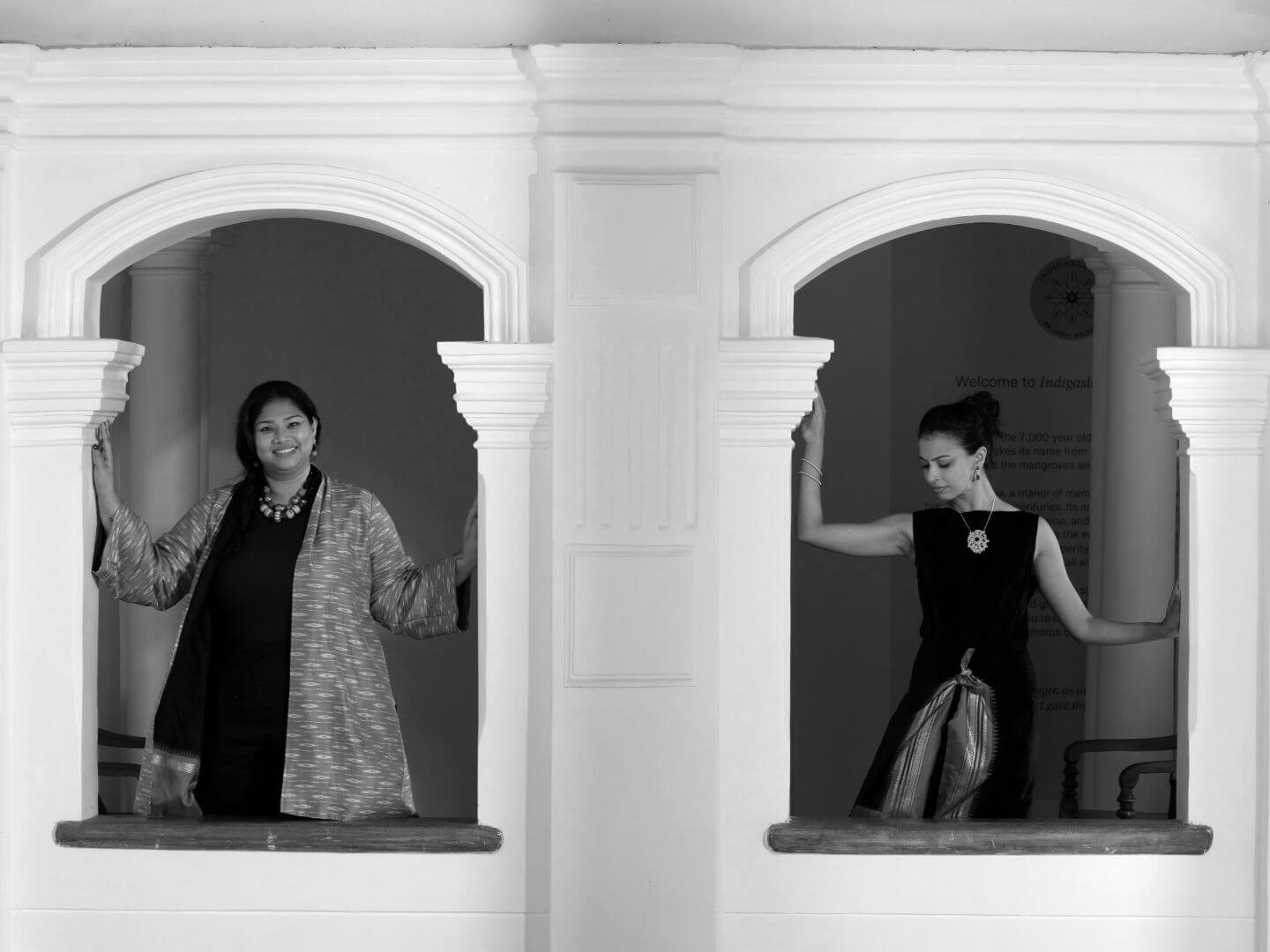
By the time diaspora communities had settled for a generation or two, something had coalesced that was recognizably its own: not quite the clothing of the homeland, not the clothing of the new country either, but a considered, confident middle distance between the two. From South Asia, but of the world. A saree draped with a tailored jacket against a London winter. A kurta worn with sneakers, the way Diljit Dosanjh stepped onto the Coachella stage in 2023 or how the sari still lingers in Fiji, comfortable in bula florals. It is the same melting of cultures that led Mehala Ford, a Sri Lankan-born, British-raised founder, to set herself the task of learning a different sari drape every Friday until the garment felt hers again, and then to open a studio store in Dulwich where South Asian designers could be discovered by London. Designers now speak openly of having wondered, for years, when they might finally see the sari or a kurta along a commercial street, not as exotic wear from elsewhere, but as beautiful clothing worn by people who live there.
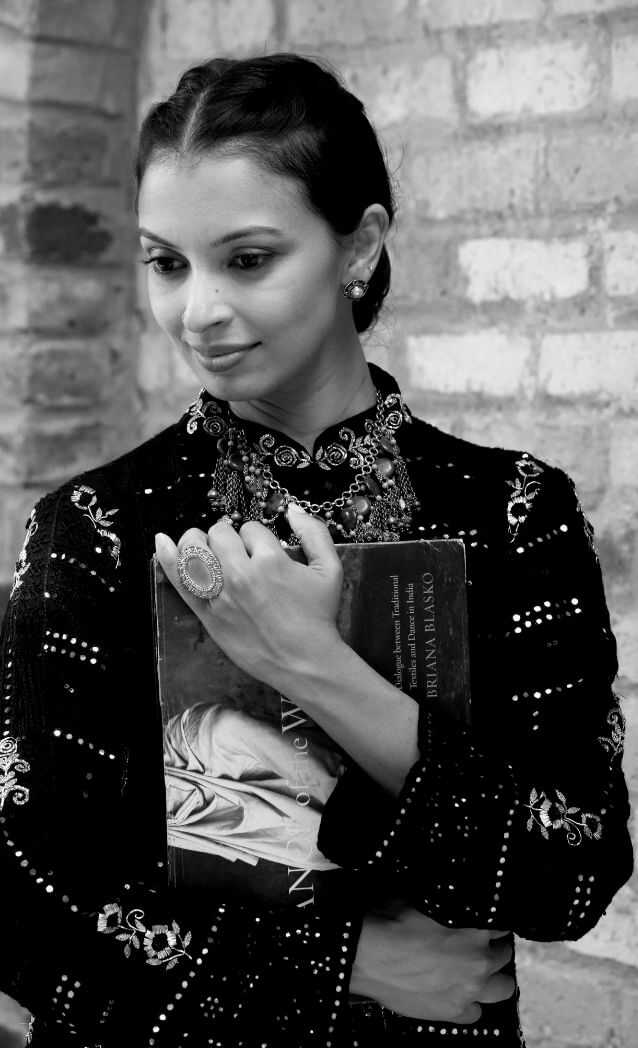
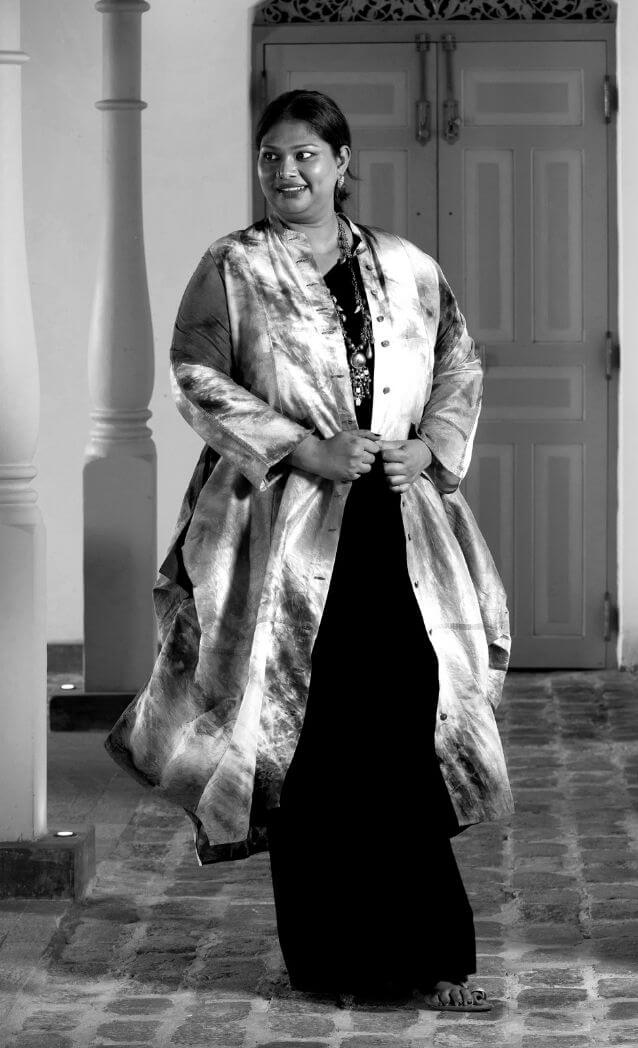
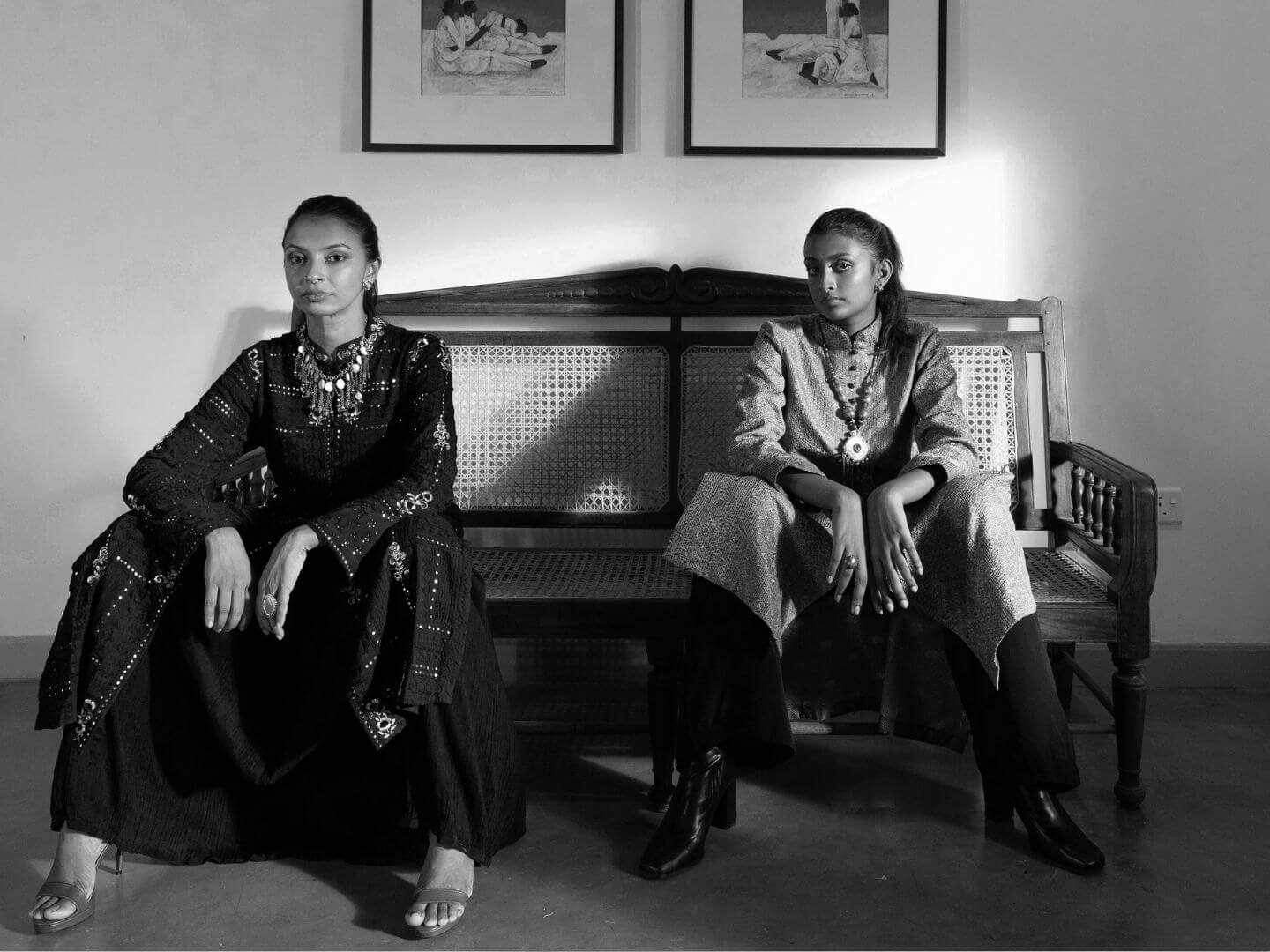
This is the genre Rithihi consciously believes in. Layering a saree beneath a structured blazer for the office, or throwing a shawl over a coat the fabric was never woven for, is a choice that makes sense in the mixed, deeply connected and diverse world we live in: to keep what is essential, and let the rest adapt. Rithihi’s own layers, sourced with care from across the subcontinent, are built with this wearer in mind, someone whose life may unfold in Colombo, London or Melbourne, someone for whom heritage and practicality don’t have to be at odds.
Three hundred or so years ago, it was a case of boarding a ship with suitcases full of bits of home and a wish not to be entirely erased by distance. But it has become a way of dressing that belongs fully to no single place, and for that reason, belongs a little to everywhere. It represents a diversification of the subcontinent’s culture and people that reaches, quite beautifully, well beyond it through its cloth that travelled.
Get in touch with us!
Monday – Saturday | Hours 10:00 am – 06:00 pm
19 Alfred House Garden Colombo 3, Sri Lanka
+94 11 2581 988 (Telephone)
+94762800220 (WhatsApp)


