
She said,
There are good omens: the house-lizard chirps,
and my dark-rimmed left eyelid flickers.
My lover is gone,
but I know he will come (yes, I know–
money must be earned, ascetics must be fed,
but most of all, I know that
we will live our life in love).
Listen to what he said.
He said the heath was so hot,
you could not tread it
but he said the he- elephant
saves the last puddle of water,
though sullied by its young,
for its mate.
He said the sight would pain the eyes–
leafless trees, dry branches,
and no mark of pleasantness.
But there the he- dove would fan
with its soft wings, to console its
tired young loving mate.
He said the hot sun would scorch
all the bamboos on the hills,
affording no protection for those who would cross.
He also said the stag would give
its own shade, there being no other,
for his suffering mate.
Virtuous, from the trial of this forest,
he will not allow my beauty to fade;
I am certain he will come soon.
(Paalai paadiya Perungadungo, Kalittokai 11, Paalai)
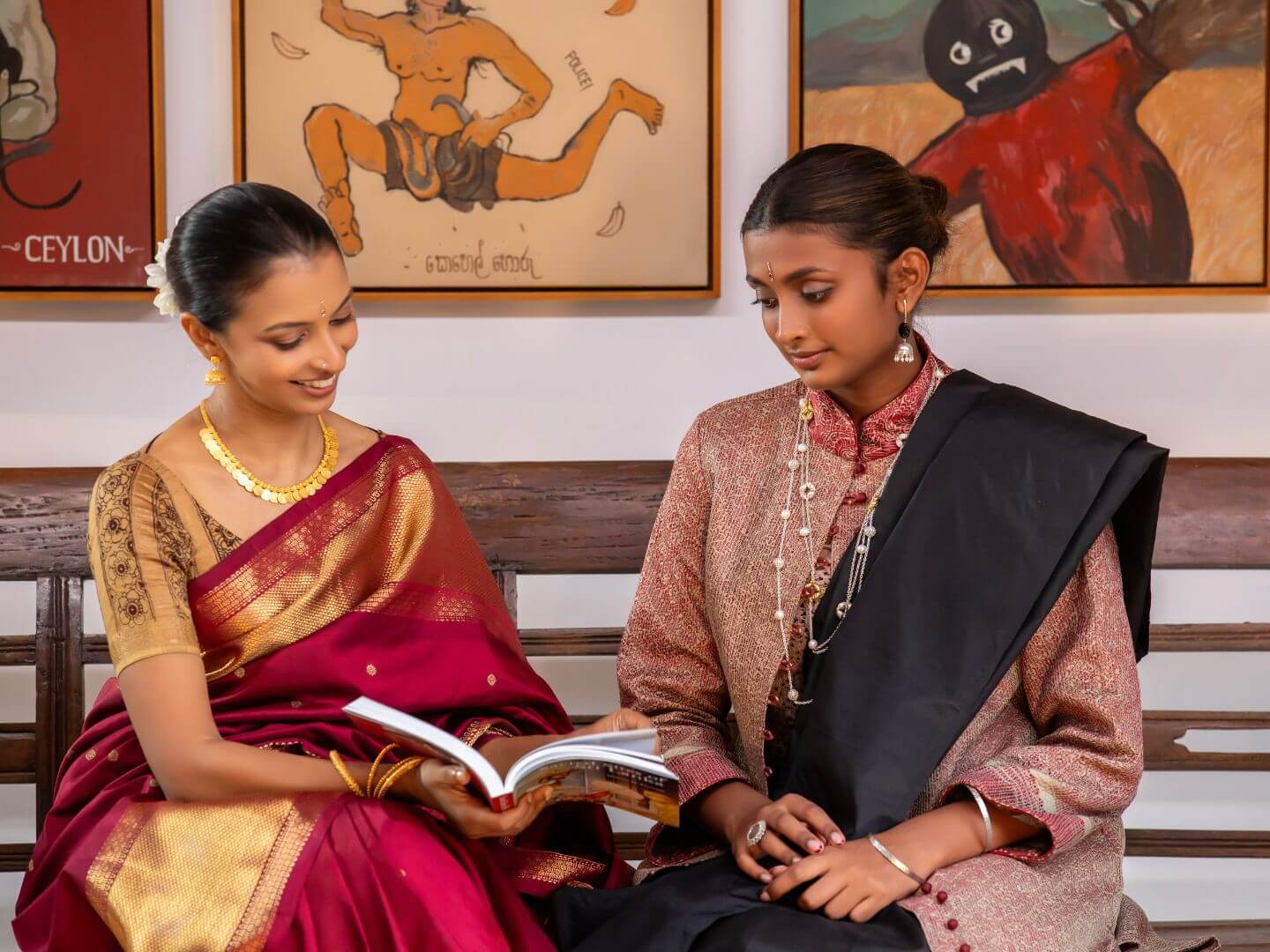
This is a translation of a third-century Sangam Tamil poem carrying strikingly human wisdom on the patience in love’s workings. Reading it, the poet fills us with visions of how acts of love unfold in nature, stirring a sense of beauty and tenderness. Each element—the elephant saving its last puddle for its mate, the dove fanning its tired companion, the stag giving its own shade—is not a mere ornament but a vital support holding up the poem’s insight. They not only bring beauty and sensory fulfillment, but they also contribute to transcending the reader towards revelation on what it really means to love, and how the space between true lovers is filled with patience, restraint, and endurance.
In the context of Eastern aesthetics, this kind of experience of beauty that leads to truth is a refined form of śṛṅgāra rasa; it’s an emotional quality that arises when beauty and truth are no longer separate experiences but one seamless state of being. It is the enjoyment of perceiving the true nature of beauty, not as surface appearance, but as essence and culmination of qualities.
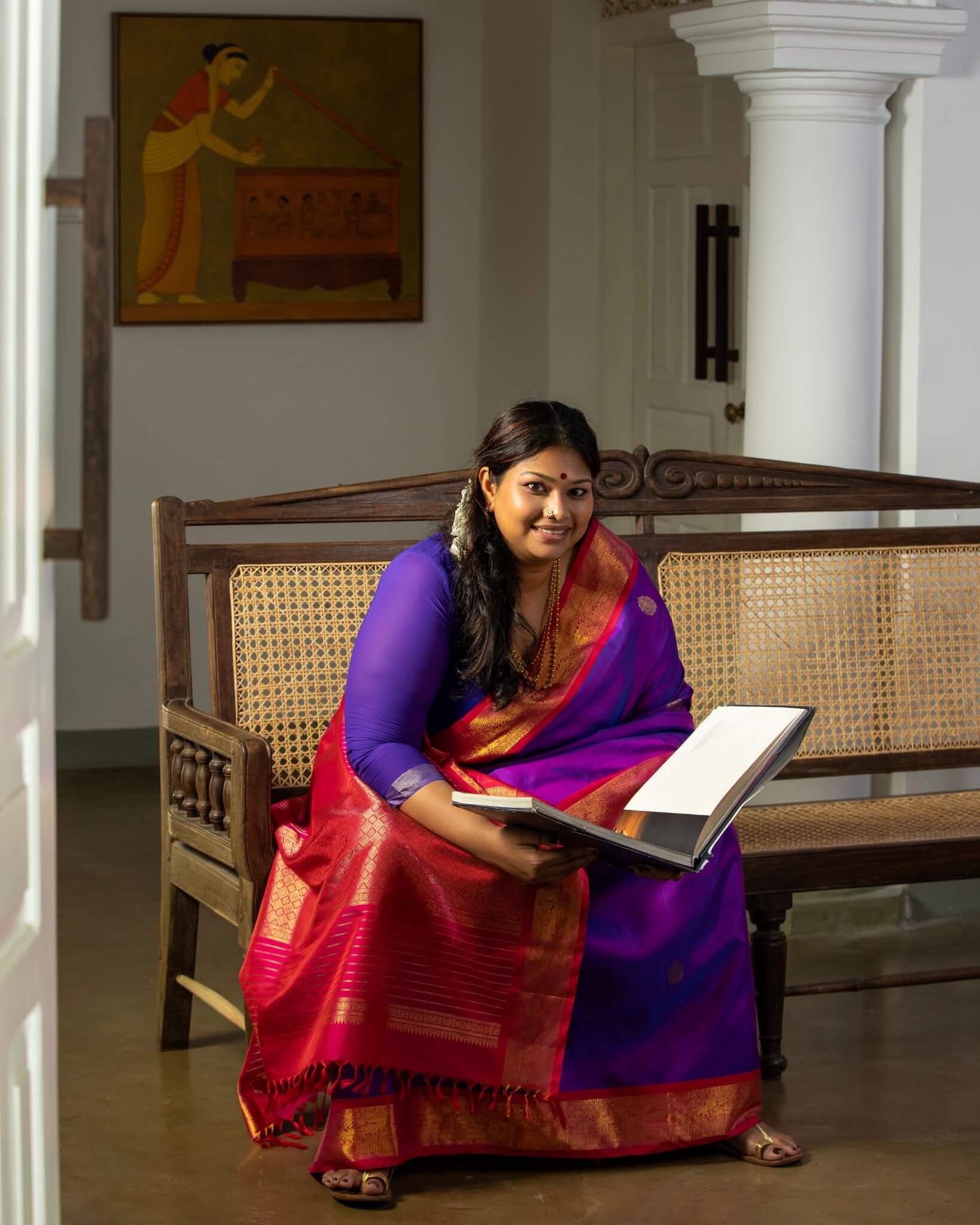
This refined śṛṅgāra rasa, where beauty and truth merge into one, appears not only in poetry but in the highest forms of material creation. The Kanchipuram silk belongs to this rare lineage. It transforms fibre, colour, motif and metal into an aesthetic experience where sensual pleasure and spiritual integrity meet, just as in the verse where feeling becomes insight. The joy in experiencing Kanchipuram silks is not just in the colour and shimmer, but in the disciplined precision of the weave, the meaning of the chosen motifs, the zari dipped in gold, the weight of the silk that settles gracefully on the body, and the emotional resonance of the stitched-in korvai border. Just as a Sangam verse captures śṛṅgāra through words, a Kanchipuram captures it through material; both are never mere adornments, but works of revelation. This Rithihi story is about the profound śṛṅgāra of Kanchipuram sarees.
“like the white-black bands on the river’s bank, faint and yet strong” (Poodanar, Narrinai 110, Paalai)
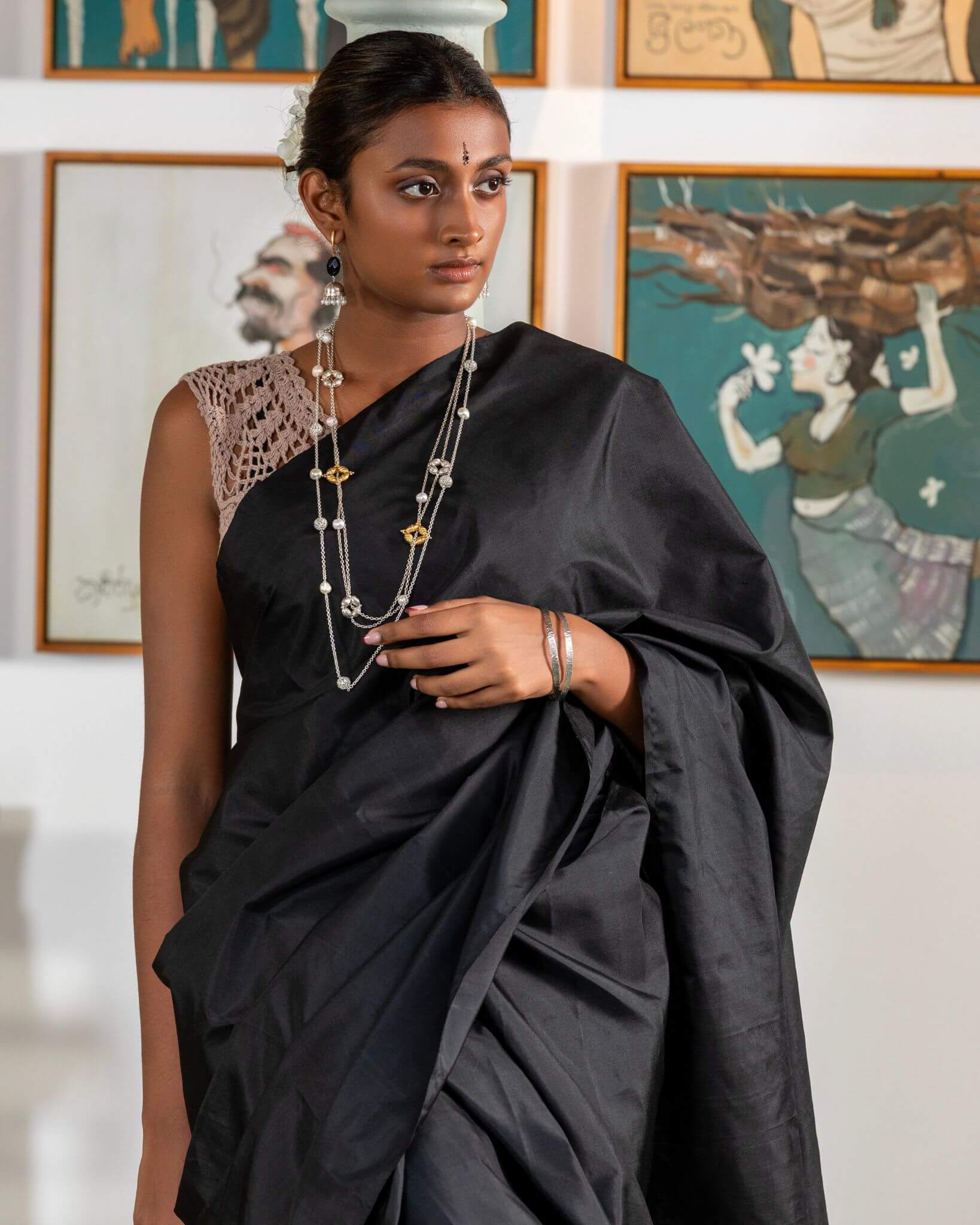
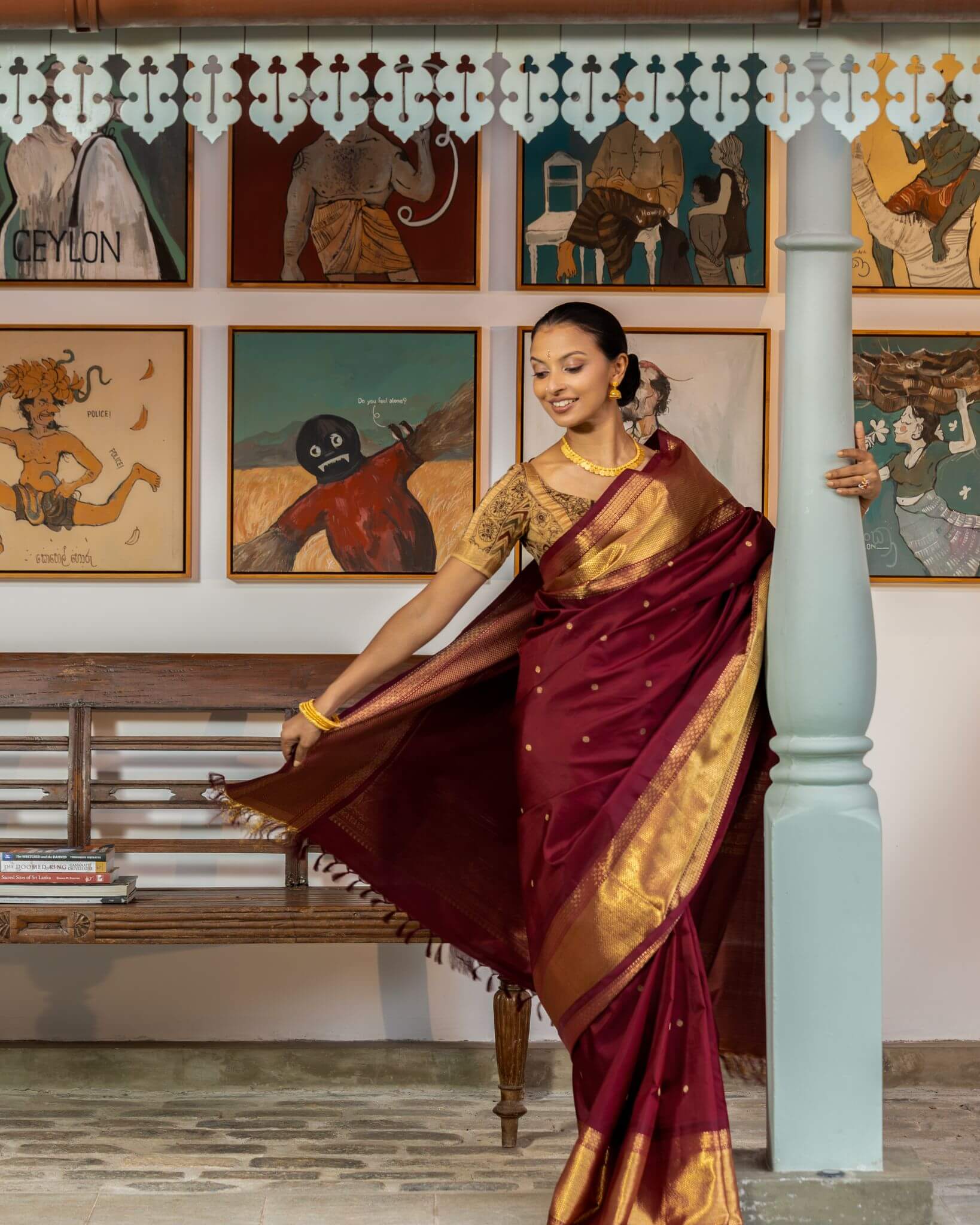
A true Kanchipuram saree is woven from pure mulberry silk, one of the strongest known natural fibres. This is what makes Kanchipurams soft to the touch yet tensile enough to endure for generations. This silk breathes with the body, regulating temperature in the cold and absorbing moisture in heat while its protein-based fibres remain gentle and hypoallergenic against skin and hair. It is a fabric that can be enjoyed for both its comforts and endurance. There is genuine splendour in real zari used in Kanchipuram sarees: it’s a core of silk or cotton wrapped in silver thread and gilded in 24-karat gold. Unlike synthetic imitations, real zari bears a muted, regal glow, a lustre that shifts with light as though alive. Its weight, derived from true metal, gives the saree its substance and fall; its longevity ensures that what gleams today will do so still, decades after. Perhaps the strongest expression of śṛṅgāra lies in the korvai, the interlocking of body and border, woven separately yet joined seamlessly by hand. The korvai border of Kanchipurams is a mark of precision, woven by two artisans in perfect rhythm, joining contrasting bodies and borders in seamless union. The korvai’s invisible join mirrors the essence of love itself: two parts meeting in perfect balance, their boundary erased through art. It is a metaphor for union, for the harmony of difference, building Kanchipurams’ legacy as the ultimate wedding sarees.
“truthful in speech and eternal in sweet” (Ettuthokai, Natrinai 1, Kurinji)
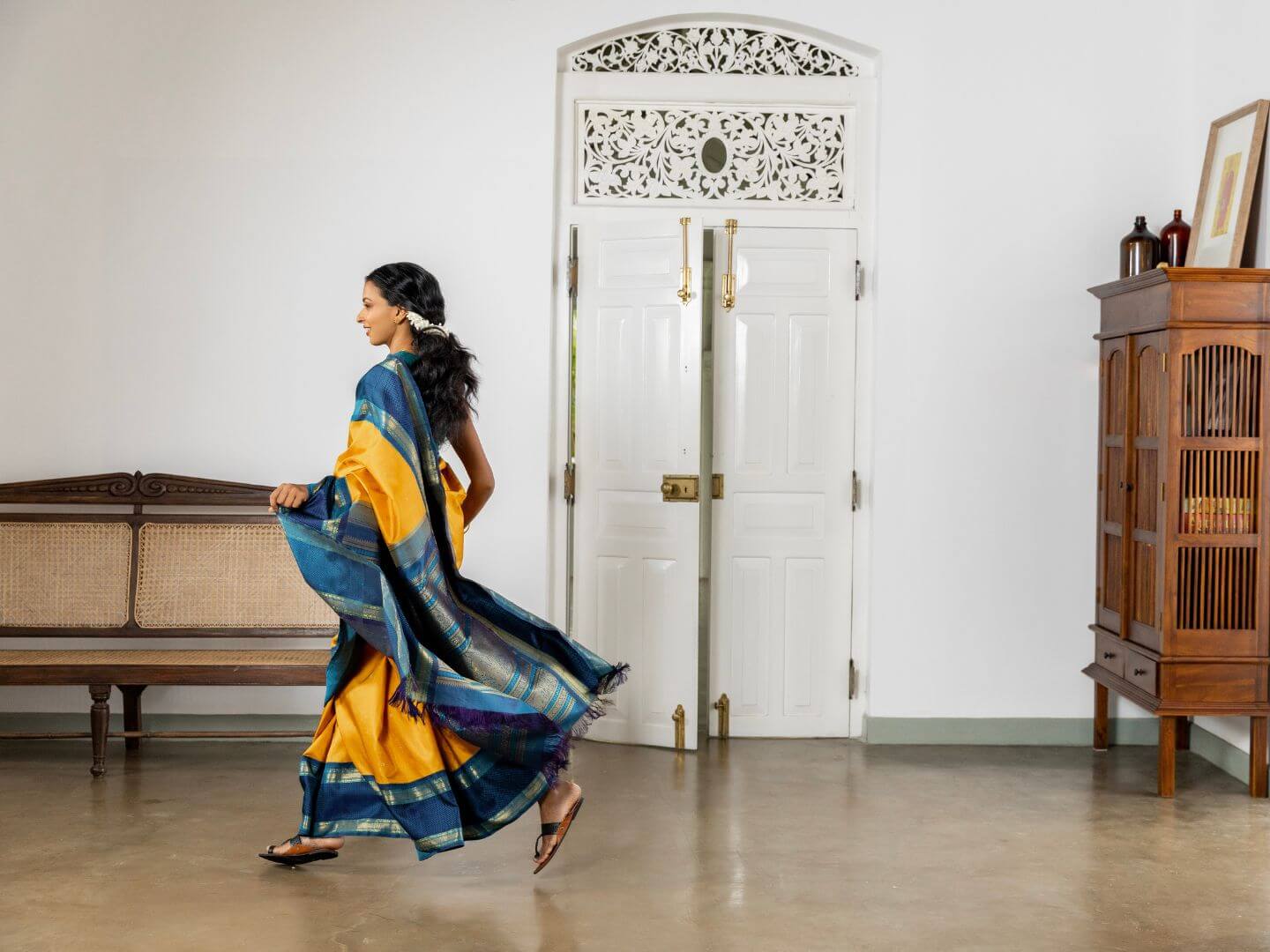
In Kanchipuram silks, visual language is never arbitrary; it’s constructed through colour, geometry, and symbols chosen with intention. Each visual element stems from a lineage of meaning, drawn from temple art, philosophy, nature or mythology. The mayil, resplendent and tender, embodies grace and divine pride, while carrying the symbolism connected to the city of Kanchipuram, once likened to a peacock. The maanga fruit motif carries the promise of fertility and renewal, recalling the sacred mango tree of Ekambareshwar Temple. Temple borders, or gopurams woven along the saree’s edge, symbolize transcendence, while rudraksha beads are elements of spiritual protection. The yaali stands firm in its mythic ferocity of the lion; the kamalam lotus speaks of purity, untouched even by the mud that births it.
Colour deepens this meaning; red for love and auspicious beginning, green for peace and renewal, gold for divinity’s touch. Patterns such as kattam (checks), vaira oosi (fine stripes), and kodi visiri (floral vines) are a disciplined geometry that helps to organize the meaning of motifs and colour. Together, these forms, colours, and geometries compose a visual dialogue that tells stories, signals universal values like purity, honour, grace and protection.
“in whatever way people are good, the earth is good” (Auvaiyar, 187, Puranaanuuru, Mullai)
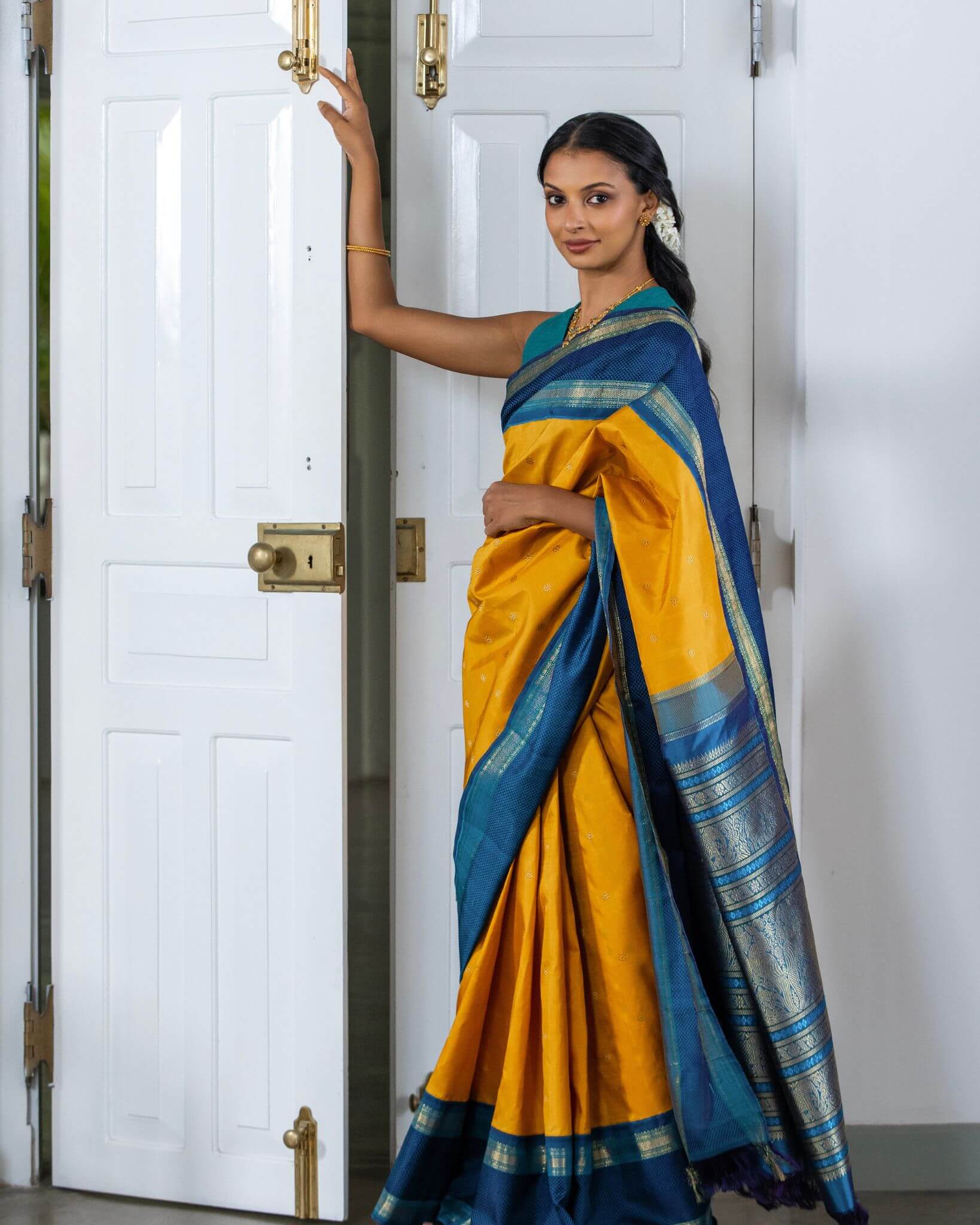
Along Kanchipuram streets peppered with weavers’ households, tea shops and saree stores alike, many looms come to life simultaneously each morning, as weavers start work. Weavers sit cross-legged, guiding the shuttle through silk and zari with complete focus, while the steady ‘tak-tak’ of the loom fills the air. Weaving a single pure Kanchipuram silk saree can take anywhere from ten to twenty-five days, depending on the intricacy of its design and zari work. Each thread must fall exactly into place; a single missed strand could change the pattern. This precision is what gives every saree its unique identity and lasting strength.
For generations, Kanchipuram’s weavers have carried this heritage forward despite facing financial hardship, competition from powerlooms, and an influx of cheaper imitations. The Government of India has recognized this craft with a Geographical Indication (GI) tag, protecting its authenticity and honouring the lineage of traditional artisans who sustain it. Yet, their challenges persist. What keeps these weavers going is loyalty to their craft and staying true to the legacy it represents; beauty and truth in union. When you choose an authentic Kanchipuram saree, you are not just investing in exceptional silk; you are directly supporting the continuity of a living heritage of unifying beauty and material truth to create one of the most treasured textiles on earth. This is why Rithihi finds it a joy to host a collection of Kanchipuram sarees here in Colombo.
In the end, both the Sangam verse and the Kanchipuram silk lead us to the same revelation: that beauty, when pursued with devotion and truth, becomes something greater than ornament. The poem shows us love made visible through nature’s tenderness; the saree reveals that same tenderness through form, texture, and light. In each, śṛṅgāra rasa transforms feeling into insight, pleasure into wisdom.
To wear a Kanchipuram is, in a way, to wear a poem, to inhabit śṛṅgāra wholly.
Get in touch with us!
Monday – Saturday | Hours 10:00 am – 06:00 pm
19 Alfred House Garden Colombo 3, Sri Lanka
+94 11 2581 988 (Telephone)
+94762800220 (WhatsApp)


